
Face Facts
Why caricaturists have to get better at what they do

I put my heart and soul into being a caricaturist. There was a time when Substack seemed like a great opportunity to talk to people in detail about what I do; to evangelise about this art-form; to explain the love, care, and thought that forms the foundation of every likeness I produce.
But posting here regularly is starting to feel like a waste of time. I frequently see creatives on other social media platforms complaining that their paid subscriber numbers on Substack are plummeting off a cliff. Mine are no exception. I have healthy follower and unpaid subscriber numbers, but people just aren’t prepared to pay for art at the moment, it seems, much less for an online discussion of it.
So, the simple fact is that, if things don’t change significantly soon, I might deem it necessary to mothball this account. I simply can’t justify the hours that go into it any more, and the day-to-day demands of freelancing have to take priority.
However, if this is going to be one of my final posts, I’d like it to be about something important . . .
I’ve been debating long and hard with myself about the wisdom of writing and posting this article. I have hedged for a long time because I run the risk of pissing off a lot of my colleagues, all for the sake of a seemingly cathartic Jerry Maguire ‘manifesto’ moment. But I feel I must try to articulate what I see as an essential truth that is damaging the art of caricature severely. I hope that fellow caricaturists will interpret what follows as more of a call to arms than a critique.
The gist of my beef is quite simple:
The current quality of caricature is just not good enough.
Art is a subjective thing, of course. And as an artist there are often elements of other people’s output that don’t appeal to you. I am 100% certain that my own work looks deficient to many eyes, in one way or another. But, in general, caricature is less subjective than many other art-forms. On its most basic level, a caricature either looks like its subject or it doesn’t.
In my view, standards in caricature have been in decline for many years. I’m not talking about the impact of political cartoons. God knows, satire globally is doing a its best to resist the endless pressure from increasingly authoritarian governments. Too many talented cartoonists have been fired from newspapers recently for simply doing their job, which is to play the essential role of court jester, licensed to point out the follies of the king to his subjects. Even in the face of retaliation from thin-skinned autocrats, political cartoons are doing remarkably well. No . . . my more focused concern is that the quality of caricature itself is just not up to scratch.
Caricature is largely about exaggeration, but it can also be about subtlety. It can say so much about the character of its targets when, for ezample, it notices the arch of a president’s eyebrow, or the set of dictator’s jaw. And character can and should be an essential part of the storytelling going on in—for example—a political cartoon.
I can probably count the caricaturists that I would personally class as today’s true masters of the art on the fingers of one hand. I won’t name names, but the half-dozen or so caricaturists who are regularly touted as being at the top of the profession’s tree are actually very poor practitioners of the art-form. You only have to look at the work of those among them who supply cover artwork for news periodicals in the USA and the UK. What these guys produce are dissatisfying renderings heavily reliant on photo-realistic effects that help make their likenesses recognizable. It’s often clear that they have based their portrayal on a single photograph, and have tried to make the caricature an exaggerated but ‘realistic’ version of that alone. This lazy approach leads only to an unsatisfactory kind of distortion, rather than to a fully resolved caricature. It’s barely a step beyond the misguided horrors of ‘big head + little body = caricature’ thinking.
The philosophy seems to be, ‘Well, President So-and-so has a double chin and a crazy hair-do, so if I really go to town on those, and then render every wrinkle and pore on his kisser in excruciating detail, I’ve got myself a caricature.’ No you haven’t. What you’ve got is the weird and unsatisfactory effect of a photographic face with some cheap tricks of exaggeration injected into it here and there. It falls between the two stools of caricature and pure illustration, becoming neither one thing nor the other.
Often, this approach is not 100% the fault of the caricaturist. Editors and art directors can be squeamish about allowing hired artistic hands to go full-on vitriolic with the exaggeration. The flawed logic of this is that slight exaggeration is less offensive to the subject and the viewer. But nobody should care if a caricature of a politician offends them. The caricature is not aimed at them. It’s about making a point to an audience. And in my experience, most politicians’ egos are so huge that it’s impossible to bruise them with a drawing anyway. As long as they are getting press, whether complimentary or critical, they’re happy. And the ones who are offended usually deserve it. Also, disquieting the audience should not be a consideration. The job of a caricature is to provoke. If you’re an editor, have the courage of your damned convictions, and let the caricaturist do his or her job. And if you’re a caricaturist, make the case to those commissioning your work that an insipid caricature is an utterly wasted opportunity.
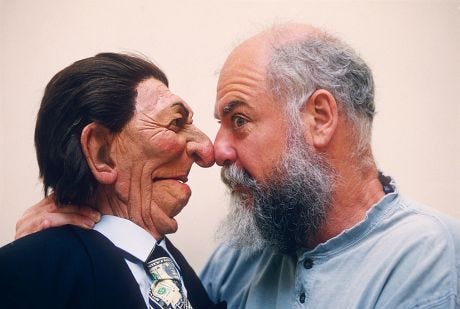
I’d love to see more caricaturists distilling the essence of public figures into their likenesses once again. But there seems to be a crisis of basic observation happening in caricature at present. Put simply, hardly anybody looks at faces closely enough any more.
When I was a kid, my mentors at Spitting Image were the show’s creators, Roger Law and Peter Fluck, and their two protégés, David Stoten and Tim Watts. Roger and Peter crafted their likenesses with excruciating attention to detail. Likewise, Tim and David used to gather as much visual information about their subjects as they could find before they picked up a pencil. They scrutinised every facet and feature of a face to help them create the most fully resolved caricatures that the time pressures of making a weekly, topical TV show would allow. I have always tried to adhere to this approach through my own career, and certainly now that I work on Spitting Image myself. I am certain it’s the only way that any would-be caricaturist stands a chance of honing their skills. I remember David telling me once that he felt there was a perfect caricature for every face. I agree with that, and I strive to find it every time I approach a new subject. I’m sure I’m never totally successful, but the quest is all.
Part of the problem is the low expectations of caricature, engendered by the general perception of this art-form. Most people associate caricature with the guys brandishing magic markers who will rattle off a funny drawing of you at a theme park or local event. I did that job myself a good deal in the early days of my career, and I know how demanding and labour-intensive it is. It’s also a great way to perfect your abilities. But it’s only one aspect of the art of caricature, which can offer so much more than a throwaway laugh.
Caricature can laser its way to the core of a subject’s character, while drawing attention to a political injustice, more directly and effectively than a thousand-word op-ed ever can. As Joseph Conrad observed, ‘A caricature is putting the face of a joke on the body of a truth.’ The machinations of half-witted despots and narcissistic billionaires, plus the widespread abuse of power, are making this planet an increasingly dangerous and terrible place in which to live, so, more than ever, we need great caricature to shine a light on our abusers’ rotten natures. Too often, though, caricature doesn’t feel like it’s meeting the moment.
Caricaturists must shoulder the blame for the generally dismissive, ‘just a bit of fun’ attitude towards their art-form that prevails in the world. And it’s this same attitude that has people prompting A.I. to pump out sterile and bland caricatures, rather than commissioning a flesh-and-bone artist to produce something with some life and love in it. As caricaturists, we have to be better at debating and honing the artistry and philosophy behind what we do amongst ourselves, and then advocating for it to the wider world, especially with the aforementioned A.I. breathing down our necks.
It pains me to say it about my chosen art-form, but part of the reason why A.I. caricature is so terrible is because the majority of the human-generated caricature on which A.I. has been trained is also, frankly, terrible. A.I. caricature is symptomatic of a wider obsession with turning the creation of art into a quick dopamine hit. Great art, though, comes from protracted effort, trial, error, and thought. When someone asks me how long it took to create one of the caricature sketches I post online, I usually tell them an hour and forty years.
We caricaturists need to be more effective evangelists for what we do. We should take our lead from Annibale Carracci, the Italian painter who was talking a lot of sense about caricature as long as 400 years ago:
‘Is not the caricaturist’s task exactly the same as the classical artist’s? Both see the lasting truth beneath the surface of mere outward appearance. Both try to help nature accomplish its plan. The one may strive to visualize the perfect form and to realize it in his work, the other to grasp the perfect deformity, and thus reveal the very essence of a personality. A good caricature, like every work of art, is more true to life than the reality itself.’
At present, Joe Public usually doesn’t know - or care to know - when he’s looking at a bad caricature, regardless of who or what has produced it. And, sadly, the same can be said of many caricaturists. So, please . . . let’s use debate among ourselves as artists about standards in the profession, plus a concerted effort to educate the wider world about the joys of caricature, as tools to change this wholly unsatisfactory status quo.
I’m grateful to anyone who has read this far. This post is unpaid, and, as I hope to start a discussion with it, I’d be enormously grateful if you would share it as much as possible. And please consider subscribing. Thank you!
I certainly understand and appreciate the effort that you and many Substack creators put into your work and the time it takes to share it with all of us. I have greatly enjoyed your Substack and hope that many more will subscribe so we can continue enjoying your insight into art and the creative effort it takes. I have no art ability so it fascinates me to get your personal insight into something most of us only dream we could do. Thanks Adrian and hopefully more will see what I see.
Reminds me of Harlen Ellison's rants within the glass teat (recommend reading, enjoyable). Great note on the mediocrity, from copywriting copying popular trends to Elsasgate, YouTube races to the bottom. Came before, conscious consumption led out again.
I ponder though, thanks for your thoughts. Best of luck with youtube.