Spin Doctors
Quacks and the power of marketing in Georgian London

One of the more popular subjects for caricature in the Georgian age was the figure of the quack doctor. In 1801, James Gillray etched a print entitled, Metallic-Tractors (shown below). This took the piss out of an American doctor named Elisha Perkins, who was the inventor of the Perkins Tractors. These might sound like farming equipment, but they were actually a simple pair of short, metal rods, and Perkins claimed that by touching them to the skin they could draw out many diseases, including rheumatism, epilepsy, inflammation, and disorders of the face.
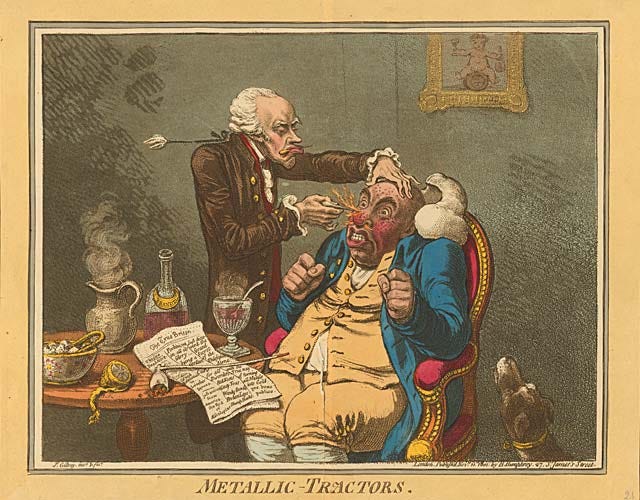
The tractors became the talk of the former colonies, and Perkins journeyed to Philadelphia to give public demonstrations of their efficacy. Congress became very excited about them, and they sold like hot cakes. A pair was even bought by George Washington. Perkins then began marketing his tractors in Europe, where his son hawked them to the public. A Perkins institute was set up in London, with a peer of the realm as its president.
The English were rather more skeptical about the tractors than their American cousins, however, as demonstrated by the publication of Gillray’s print. But it seems Perkins took the view that there was no such thing as bad publicity, and he liked Gillray’s joke at his expense enough to write a word or two of thanks to the caricaturist, adding that he hoped the etching would be sold in many other print shops. As you’ll see, Perkins wasn’t the only quack of his era with impeccable marketing instincts . . .